A Summary of Blomquist, W., & Schlager, E. (2005). Political Pitfalls of Integrated Watershed Management. Society & Natural Resources, 18(2), 101–117. https://doi.org/10.1080/08941920590894435

Blomquist and Schlager are a political scientist and professor of public policy, respectively. This work is about some issues that they’ve found with the concept of “integrated watershed management.” They define this term as the synthesis of two ideas– (1) that watersheds are the best way to manage water, and (2) that political organizations should be created at the level of the watershed in order to carry out the idea of (1). While they understand that there are few examples of this integration of watersheds and politics, the point of their paper is to illustrate some of the flaws of this approach.
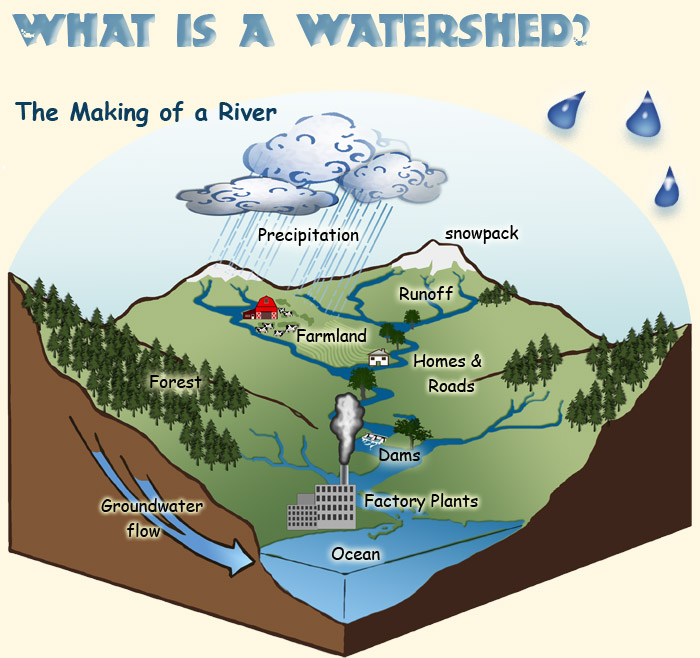
First, they argue that it’s hard to define what a watershed is. For instance, a watershed may be as large as the Mississippi basin, or as small as a creek. There is confusion at the regulatory level as how to best define the appropriate size for an integrated management approach. Their point is that ultimately how we define a watershed is yet again a relatively arbitrary choice which reflects political considerations.
Second, simply drawing political boundaries at the watershed level does not solve questions about representation, stakeholder management, democracy, or accountability, let alone questions about organization and the decision-making process (e.g. power). And these are quite important for decisions to have legitimacy! Always, someone will be left out of the process who it might have been included, and Blomquist and Schlager point out that it may actually be reasonable for stakeholders outside of the watershed to be included in decisions, thus invalidating the concept of a watershed as a valid political unit.
They close with a case study in which several watershed management organizations and municipalities came into conflict over water in the 1990s. Their point is that the resolution of the dispute brought to the forefront the idea that any solution must necessarily be political and that it would not be without conflict between groups.
Key takeaways
- Watersheds are not neutral boundaries. When boundaries are set, that’s a political act.
- Water and control of it is a political act.
- Political considerations will always be present and watershed-level decision making bodies won’t be able to get away from this fact.

 Cultural Water Studies