
Video by Stuart Deets, November 2020. Video of the trains that run along the river while a co-traveler whistles in the background.
How can a river be so many things at once? I took the video above while traveling on the Mississippi River in October-November 2020, from Bdote to Hastings, MN. In the video, we have been traveling for four days, and a train thunders along the river in the evening. Later that night I would be awoken by the howling wind and cold, and by the sounds of a barge on the river.
How can a river be both industrial and recreational? We tend to think of the two as separate and distinct, yet they hang together throughout the course of the river. The next morning, after filming this video, I noticed again, and yet also for the first time, the gradual accretion of sediment along the river. We were camping on one of the islands on the river, many of which have flood lines from the spring melt. You can tell clearly the high water mark, because it’s indicated not only by the mud and dirt, but also by the leaves, which take on a different texture, and the kinds of plants and trees which grow on different elevations. The difference of only a few inches of elevation can either mean submersion in the spring floods or relatively dry ground.
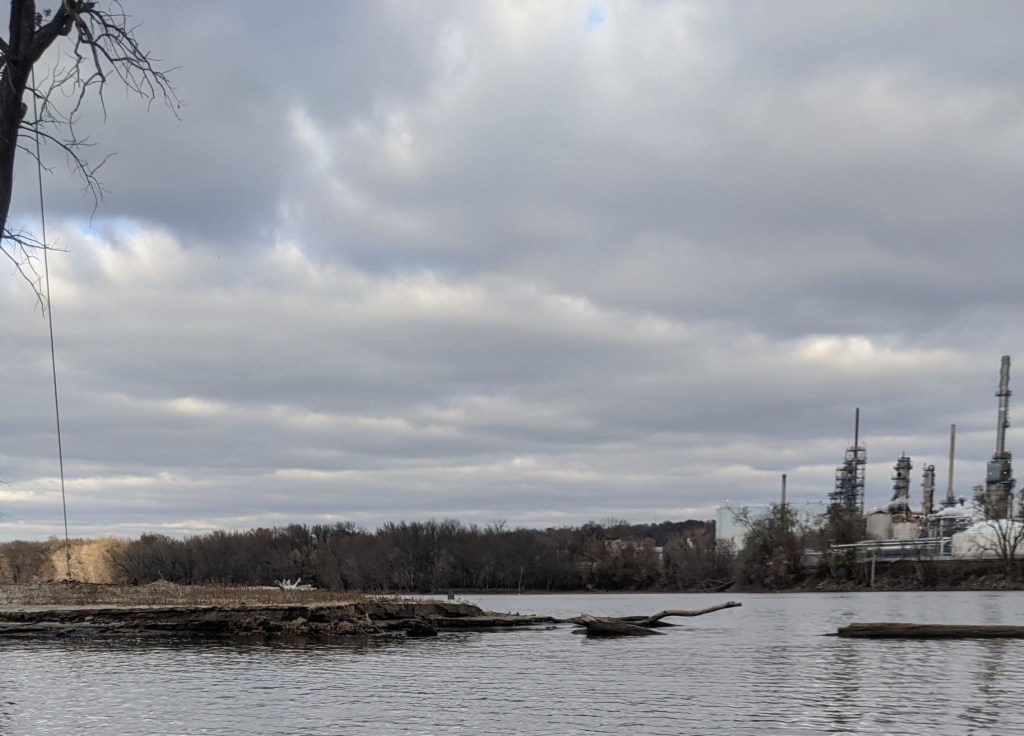
Photo by Stuart Deets, on the Mississippi River. October 2020. Image of an island with a rope swing and an oil refinery in the background.
Along this line, there is a yearly process of withdrawal and renewal. And along the rest of the island, the water laps constantly, moving up and down with the tide and the river flow. These waves deposit sediment up and down the islands, depending on the height of the river, and when the water is at a low point, there are topographical rings around the island, leaving a sort of index of previous high water marks.
A fundamental question about water is how it comes to mean the things that it does. We ought to think about the culture of rivers, and the culture of water more generally, as a process of sedimentation. A constant renewing and withdrawing, leaving indexical marks along the way, in the same way that a river leaves deposits of silt, dirt, and other materials. This is a kairotic understanding of meaning, which is a fancy way of saying that meaning is based on time and specific temporal conditions. There are certain meanings that are possible at any given moment, and these accrue slowly, over time, each leaving a particular mark. But most are washed away quickly. Some persist for a time and then disappear. And some remain for decades, until a record flood, when they are replaced by some, newer, line.
We ought to think about the culture of rivers, and the culture of water more generally, as a process of sedimentation.
Our world is constructed on the basis of such tiny lines, small changes that were only possible at a particular time because a particular set of conditions. And yet at certain times, great change is possible.
We are now at one of these times. There is a concerted effort to protect and re-wild many of the rivers in North America and globally. A rewilded river is one where space is given for the river to run wild, without constraints on its flow, and with abundant space for wildlife to live their lives without the dominant influence of humans. It is an attempt to return rivers to their pre-industrial state. The turn to re-wild the rivers is just another line in the accretion of meaning that are water and rivers, but it’s an important one for the sediments it might cause to withdraw. A re-wilded river is one where different things are possible and encouraged, one where different conditions make a wild and, perhaps, recreational river the dominant one.
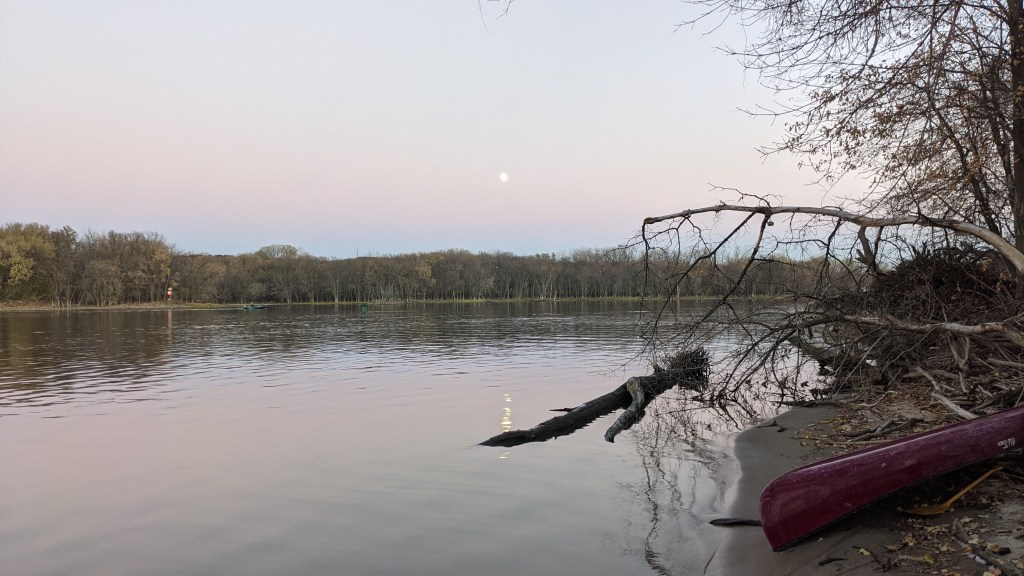
Photo by Stuart Deets on the Mississippi River. October 2020. Image of the canoes docked for the night on the beach as the moon rises.
This is not perfect. Rivers are things which defy our understandings of them. The industrial river will still be there. There are ideological problems with the idea of the “wild” that have been well explored. There are barriers that prevent people from making a river a “recreational” river. We must take care to remember the ways that humans are not separate from but a part of nature. But it’s the right time for us to push for a new high water mark and accept that rewilding rivers is better than what came before. That’s pretty much the best we can hope for. And someday, when we and the rivers are ready, we can push for a slightly different meaning of the river, that will be better. Things and meaning will continue to accrete. Sediment will continue to flow. And the rivers will continue to be strange things, which hold many different meanings at once.
Post written by Stuart Deets, Co-Editor of Cultural Water Studies. You can follow him on Twitter @stuart_tweets.

 Cultural Water Studies